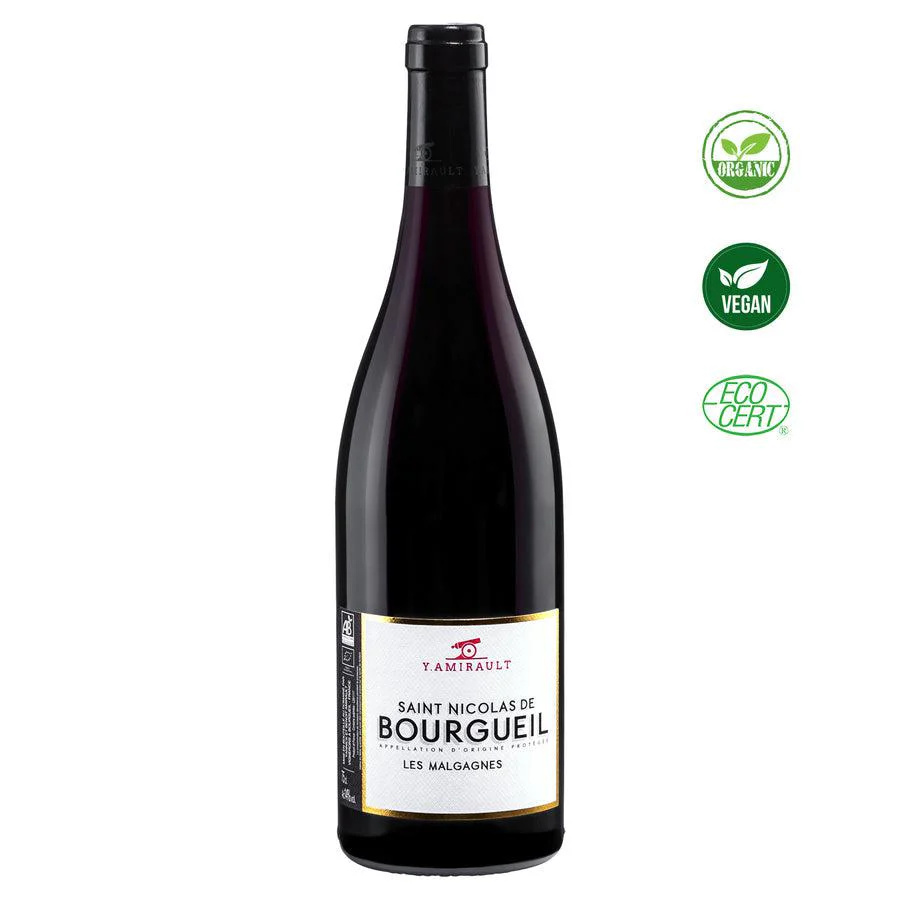
Yannick Amirault Saint Nicolas de Bourgueil Les Malgagnes 2020
The original Yannick Amirault parcel is Les Malgagnes, in St Nicolas de Bourgueil, located on the limestone côte, but not quite so far up the slope as the other three limestone lieux-dits which are further along, in Bourgueil. In Les Malgagnes the Amiraults have 2 hectares of vines, split between two parcels, aged on average 50 years. The superficial soils are rich in pale clay, with limestone beneath. Only the fruit from the upper section (above the grassy strip running through the middle of the lieu-dit, if you visit), where the limestone is much closer to the surface, is used for this cuvée. It sees a four-week maceration with an élevage lasting 12 months in large barrels. In 2015, however, a portion was also aged in three large amphorae. Of these, one was bottled as a special cuvée, Les Malgagnes Amphore, while the other was blended with the wine which underwent traditional élevage in oak. In subsequent vintages Yannick and Benoît have continued to produce these twin cuvées, which make for interesting side-by-side comparisons.
Original: $60.94
-65%$60.94
$21.33Product Information
Product Information
Shipping & Returns
Shipping & Returns
Description
The original Yannick Amirault parcel is Les Malgagnes, in St Nicolas de Bourgueil, located on the limestone côte, but not quite so far up the slope as the other three limestone lieux-dits which are further along, in Bourgueil. In Les Malgagnes the Amiraults have 2 hectares of vines, split between two parcels, aged on average 50 years. The superficial soils are rich in pale clay, with limestone beneath. Only the fruit from the upper section (above the grassy strip running through the middle of the lieu-dit, if you visit), where the limestone is much closer to the surface, is used for this cuvée. It sees a four-week maceration with an élevage lasting 12 months in large barrels. In 2015, however, a portion was also aged in three large amphorae. Of these, one was bottled as a special cuvée, Les Malgagnes Amphore, while the other was blended with the wine which underwent traditional élevage in oak. In subsequent vintages Yannick and Benoît have continued to produce these twin cuvées, which make for interesting side-by-side comparisons.