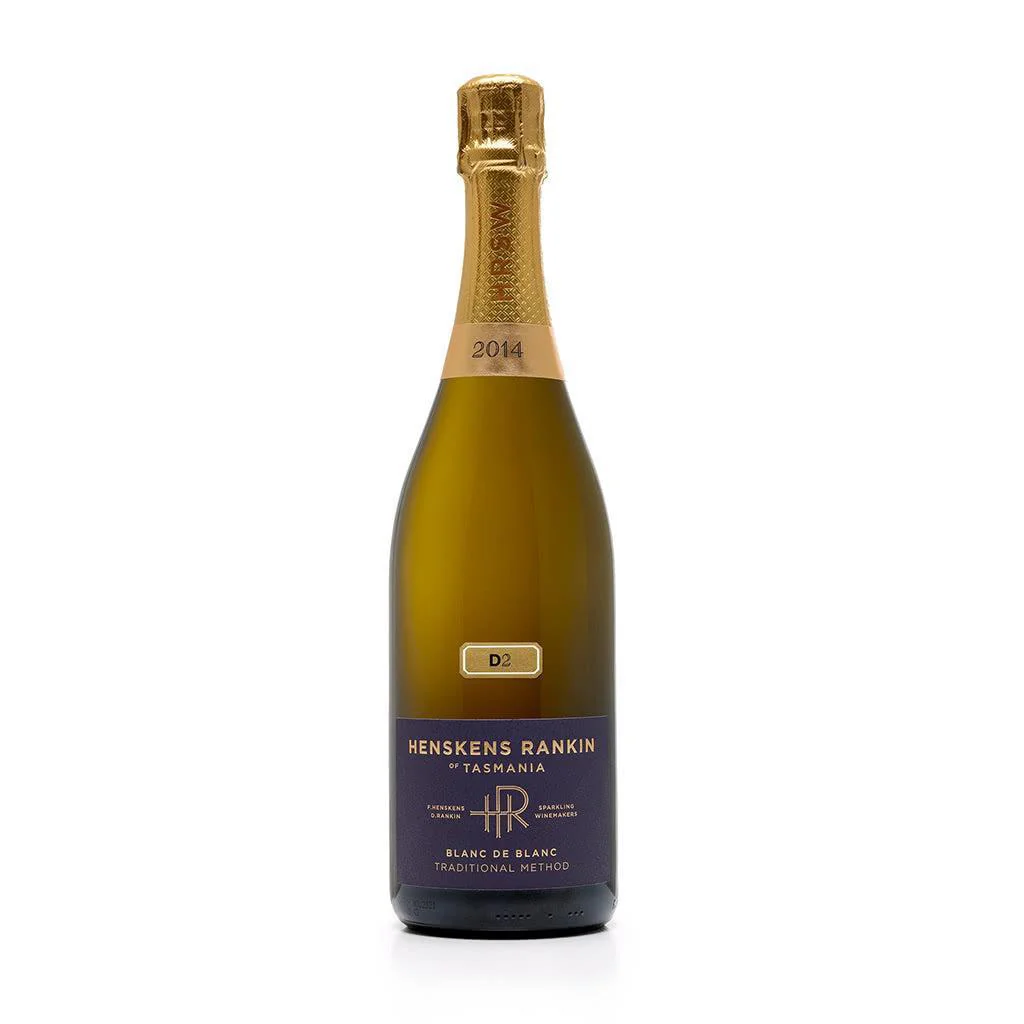
Henskens Rankin D2 Blanc de Blanc 2014
Vintage notes
Overall a warmer than average year with even bud-burst. Some spring frosts however, and in the north of the state, squally, wet and windy conditions around flowering and fruit set dramatically reduced yields.
Vineyard notes
Established in 1994, this 2 ha, E-NE facing vineyard is nestled in the West Tamar foothills near the small township of Winkleigh. It has duplex acid soils, sandy loam topsoils over clay formed from Brown Chromosols.
Winemaking
Envisaged as a pure expression of Chardonnay over time, a single cage (504 bottles) is riddled and released each year over a 3-4-year period. At processing (hand harvested fruit, whole bunch pressing) the free-run/cuvée was separated from the pressing fraction. The current wine was made purely from cuvée.
Primary fermentations were conducted in oak barriques and puncheons. Some were completely spontaneous, conducted by ambient yeast. Other barrels were inoculated with one of two commercial yeast strains. The second ferment (tirage) in the bottle was achieved conventionally with a commercial priss de mousse. Malolactic fermentation (MLF) was blocked by use of low temperature tirage and storage.
Original: $79.39
-65%$79.39
$27.79Product Information
Product Information
Shipping & Returns
Shipping & Returns
Description
Vintage notes
Overall a warmer than average year with even bud-burst. Some spring frosts however, and in the north of the state, squally, wet and windy conditions around flowering and fruit set dramatically reduced yields.
Vineyard notes
Established in 1994, this 2 ha, E-NE facing vineyard is nestled in the West Tamar foothills near the small township of Winkleigh. It has duplex acid soils, sandy loam topsoils over clay formed from Brown Chromosols.
Winemaking
Envisaged as a pure expression of Chardonnay over time, a single cage (504 bottles) is riddled and released each year over a 3-4-year period. At processing (hand harvested fruit, whole bunch pressing) the free-run/cuvée was separated from the pressing fraction. The current wine was made purely from cuvée.
Primary fermentations were conducted in oak barriques and puncheons. Some were completely spontaneous, conducted by ambient yeast. Other barrels were inoculated with one of two commercial yeast strains. The second ferment (tirage) in the bottle was achieved conventionally with a commercial priss de mousse. Malolactic fermentation (MLF) was blocked by use of low temperature tirage and storage.